USC News

Loading...

x

Loading...

    When science meets cinema

    September 27, 2012

    Looking for an innovative, interdisciplinary classroom project? Now is the time for professors in all USC schools to motivate their students to enter the 2012 Science Film Competition.

    The deadline to register is Oct. 12. The first-prize winner will receive $3,000, with $2,000 and $1,000 going to winners of the second and third prizes, respectively. There will also be honorable mentions and possibly special category prizes.

    Undergraduate and graduate students from throughout USC are encouraged to compete.

    “Faculty all over USC and on all campuses are crucial to the success of this,” said Clifford Johnson, professor of physics and astronomy at the USC Dornsife College of Letters, Arts and Sciences, who organizes the contest with help from faculty and staff at the USC School of Cinematic Arts (SCA). “They can help students connect to other students to form teams [or] encourage students to work on an issue in their classes that might be explored in film, so that it is both a class project and an eligible film.

    “Many faculty members have students doing research with them,” he added. “This is a great opportunity for some of the work in their labs to be showcased in films.”

    The competition, which began last year, is open to teams of USC students from any program on any of the USC campuses. Entries must come from interdisciplinary teams of students. Johnson is hoping students from the Health Sciences Campus also enter the competition, as well as students doing research at the USC Wrigley Marine Science Center on Catalina Island.

    “We need more students from all over USC, in political science, the humanities, business, law, fine art, architecture, theater, to name a few areas,” Johnson said. “There are many ways that science intersects with all those aspects of our lives that are great subjects for film.”

    Each team is asked to enter a short film that explains and illustrates a scientific concept, principle or issue for people who are not experts in the subject. The film can focus on any genre — documentary, animation, drama, even romantic comedy.

    The objective is to better communicate science to the public. In essence, the competition helps future filmmakers, scientists, writers, journalists — or students pursuing any field — learn how to communicate scientific ideas.

    “The key to getting better communication about science in the media, in entertainment and in all aspects of our daily lives is through increased contact between those with the knowledge and those with media expertise,” Johnson said. “Right now, most journalists and filmmakers, either in documentary or narrative, aren’t in the practice of working with scientists even when they’re doing something involving science.”

    The competition, he added, is an opportunity for those studying divergent fields to work together. At least one person on the team must be studying a science or engineering-related field, and at least one team member must be studying cinema, journalism or communications.

    Nineteen teams consisting of 90 students entered USC’s first science-themed filmmaking competition. USC Dornsife’s Kevin Le and SCA’s Edward Saavedra, both sophomores at the time, took the top prize for their short movie Time.

    Describing why time moves only forward, Le and Saavedra explained in the film that one first must understand a fundamental law of physics: the increase of entropy. The law describes the tendency for systems to go from a state of higher organization to disorder.

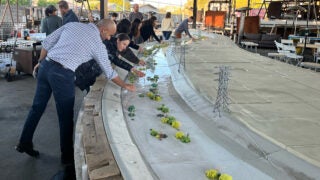
    The pair used food to describe a complex idea — cooking and filming for three days in Saavedra’s Cardinal Gardens apartment across from the University Park Campus with about $30 worth of groceries.

    Le, who is now a junior earning bachelor’s degrees in physics and mathematics, said participating in the contest taught him things he would have never learned in a classroom.

    “First of all, teaching is the best way to learn something,” he said. “Once you have worked to package concepts into language, sounds and visuals, it solidifies it in your own mind. But doing this through a medium like film also gave me an opportunity to learn and use screenwriting and cinematography.”

    Working with Saavedra, Le realized that a scientist’s moral code, when explaining nature to a layperson, should be never to underestimate your audience.

    “Do not belittle your audience because you know more than them,” Le said. “Instead, communicate as if a scientist has a moral responsibility to teach, and the layperson to learn. At the same time, a scientist must also sit back and listen to the lessons about nature that an artist gives.

    “This sort of exchange is good because I think that it is only in the connections among all human efforts — the arts, sciences, philosophy, etc. — that we can learn the truth,” he explained. “With that in mind, Ed and I will be competing this year, and we are aiming for first place.”

    The films produced by students can have a life beyond the competition, according to Johnson, who said there is interest from organizations to repurpose the material for their audiences. For example, the films could be used by networks looking for Web content or the Science, Technology, Engineering and Mathematics Education Coalition wanting to interact with universities.

    Johnson said he would be happy to visit any USC faculty member’s class at a time of their choosing prior to the Oct. 12 deadline to spend five minutes explaining the competition to their students.

    A jury of USC faculty and outside experts will determine the winners. After the registration deadline, a series of events for contestants will be offered. One event will be a workshop about film production led by Joe Wallenstein, head of production at SCA, who oversees and administers all aspects of filming by students making 2,000-plus films each year. Other workshops will involve guests who are filmmakers and/or scientists.

    The final deadline for submission of completed entries is Jan. 10. And on Jan. 23, a film showcase and awards ceremony will be held at SCA.

    Le gave some advice to students planning to enter this year’s competition.

    “Know your audience and really pay attention to what you’re trying to convey,” he said. “Work under the presumption that they have no knowledge of the subject but also that they have infinite intelligence.

    “That being said, it’s still very hard to explain scientific concepts, so make sure you spend a decent amount of time on the script. I think Ed and I spent two hours on a single sentence on our last project. For Ed and I, it was important that we enjoyed working on this film. It never felt like a chore.”

    To learn more about the competition, visit sciencefilm.usc.edu


    Last year, eight short films were entered in USC's first science-themed movie competition, organized by Clifford Johnson, professor of physics and astronomy at USC Dornsife.