Earth’s past is a warning for the future
Too much carbon dioxide in the atmosphere will make the oceans more acidic and imperil key parts of the marine food chain – it has happened before and can happen again, scientists warn.
Earth scientists representing 18 institutions worldwide – including USC – have united to examine the geologic record of the past 300 million years for clues about what the future holds if atmospheric carbon dioxide levels continue to increase.
The study is the first of its kind to survey the geologic record for evidence of ocean acidification over this extensive time period.
“What we’re doing today really stands out,” said lead author Bärbel Hönisch, a paleoceanographer at Columbia University’s Lamont-Doherty Earth Observatory. “We know that life during past ocean acidification events was not wiped out – new species evolved to replace those that died off. But if industrial carbon emissions continue at the current pace, we may lose organisms we care about – coral reefs, oysters, salmon.”
The article, which appears today in Science, included contributions from 21 scientists, among them Rowan Martindale, doctoral candidate in the Department of Earth Sciences at the USC Dornsife College of Letters, Arts and Sciences, and colleague Sarah Greene PhD ’07, a postdoctoral researcher at the University of Bristol.
“The modern ocean chemistry is changing, and nobody really knows exactly what’s going to happen,” Martindale said. “This research examines several different geological events that are similar to what is occurring today.”
As the quantity of carbon dioxide in the atmosphere increases, more of it is absorbed by the world’s oceans. Carbon dioxide and water bind together to create carbonic acid, which is used to make soft drinks bubbly though it also makes water more acidic.
Increasing the dissolved carbon dioxide in the ocean leads to a drop in ocean pH. The average ocean pH already has dropped from 8.2 to 8.1 since the industrial revolution and may decrease another 0.2 to 0.3 pH units by the end of this century.
On the pH scale, which rangers from 0 to 14, lower numbers are more acidic, higher numbers are more basic, and middle numbers are neutral. Lemon juice is about a 2, black coffee is about a 5, baking soda is a 9 and bleach is a 13.
Like the Richter Scale for measuring earthquakes, the pH scale is logarithmic – so pH 7 is 10 times as acidic as pH 8.
“The ocean’s not turning into lemon water or vinegar,” Martindale said, but even a small change on the pH scale can be significant for marine life.
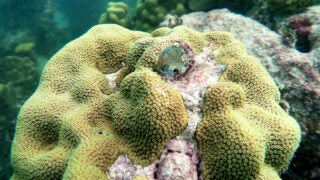
The problem is that greater acidity (lower pH) affects some of the keystone species of the ocean – coral reefs, mussels and clams, whose hard shells are dissolved by carbonic acid. They react much the same as a tooth that is left to sit in a glass of cola.
Further, changing the pH of the ocean also affects nutrients like nitrogen – a key element to sustain sea life – that water can hold.
“Why do you care? Because that could cause the collapse of the fisheries,” Martindale said.
The contribution written by Martindale and Greene focused on the boundary between the Triassic and Jurassic periods, a time when carbon dioxide in the atmosphere doubled or possibly even tripled – a time that also happens to be one of the five biggest extinction events in Earth’s history.
Roughly 200 million years ago, almost half of the genera (that’s the plural of “genus”) in the oceans died off.
Scientists first suspected an asteroid impact as the cause. However, the lack of a crater from that era that is big enough suggests otherwise.
At the Triassic/Jurassic boundary, the continents, which were all connected as the supercontinent Pangaea, began to “unzip” into the separate continents we know today.
The zipper was a solid string of volcanic activity stretching from Morocco to Newfoundland – one of the largest eruptions in the history of the planet. With the resulting sudden increase in atmospheric carbon dioxide from these eruptions, carbon dioxide in the ocean also would have increased, driving down the ocean’s pH.
At that point in the geologic record, there is a complete lack of limestone or coral, both of which are dissolved in acidic water.
“Something weird was going on in the ocean,” Martindale said.
The Triassic/Jurassic event is one of the worst-case scenarios. And though the amount of carbon dioxide in the atmosphere at that time dwarfs what is currently there, the current rate of increase is what should give us pause, Martindale said.
During the Triassic/Jurassic boundary, volcanoes across the entire landmass of the Earth were erupting constantly, and atmospheric carbon increased at a rate of 1 gigaton – about 2,200,000,000,000 pounds – per year.
Today, it is increasing at a rate of 8 gigatons per year, and the rate of increase gets faster every decade.
The research was funded by the National Science Foundation, Past Global Changes, the USC Wrigley Institute for Environmental Studies and USC Dornsife, as well as the National Sciences and Engineering Research Council of Canada, the Society for Sedimentary Geology, the American Association of Petroleum Geologists, the American Museum of Natural History, The Geological Society of America, the Evolving Earth Foundation, the Institute for Advanced Study and The Paleontological Society.
USC Dornsife alumna Sarah Greene and Rowan Martindale, a doctoral candidate in earth sciences, contributed to a recent study that looks at geological records for evidence that mass extinction events may have been caused by ocean acidification.